
The United States launched "proportional" strikes against Iran on Tuesday after an Apache helicopter was shot down near the Strait of Hormuz, shattering the fragile April ceasefire.
The United States launched "proportional" strikes against Iran on Tuesday after an Apache helicopter was shot down near the Strait of Hormuz, shattering the fragile April ceasefire.
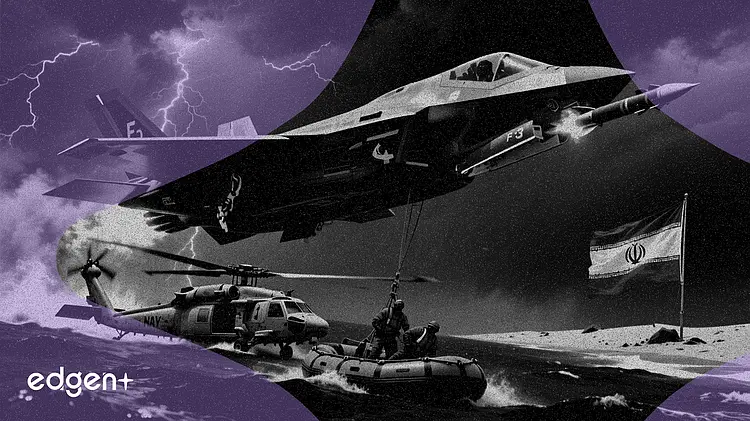
The United States launched "proportional" strikes against Iran on Tuesday after an Apache helicopter was shot down near the Strait of Hormuz, shattering the fragile April ceasefire and threatening to disrupt a waterway that handles about 21% of global oil trade.
"US Central Command has launched self-defence strikes against Iran," the command posted on X. "The mission is a proportional response to an unjustified Iranian aggression."
The AH-64 Apache went down Monday near the coast of Oman while patrolling regional waters, according to Central Command. Both crew members were rescued within about two hours by an unmanned surface drone operated by Task Force 59 — the first such water rescue by a US military drone, officials said. President Trump confirmed the pilots were "fine." The incident came hours after Iran and Israel exchanged fire in the most serious breach of the April ceasefire, with Iran firing missiles at Israel on Sunday and Israel striking central and western Iran on Monday, killing at least two Iranian air defense personnel, according to state broadcaster IRIB.
The escalation threatens to unravel the April ceasefire that Trump had touted as a prelude to a broader nuclear deal with Tehran. Trump said Monday that negotiators were in the "final throes" of talks, with a deal possible in "two or three days," while simultaneously ordering both sides to stop "shooting" in a Truth Social post. The Strait of Hormuz remains the critical flashpoint: any sustained disruption could push oil prices sharply higher, with Iran having previously threatened to close the waterway.
Ceasefire unravels as Israel-Iran exchange widens
The US strikes follow a weekend of escalating hostilities between Israel and Iran that threatened to collapse the April truce. Iran launched missiles at northern Israel on Sunday — its first such bombardment since the ceasefire — in retaliation for Israeli strikes near Beirut targeting Hezbollah. Israel responded with airstrikes on central and western Iran, marking the most serious exchange since the April agreement.
Trump spoke with Israeli Prime Minister Benjamin Netanyahu on Monday morning, the second call in two days between the leaders. "Bibi, you better be careful, or you will be on your own very soon," Trump warned, according to his account of the conversation. Iran, meanwhile, said any peace deal must include a ceasefire in Lebanon, where Israel has continued operations against Hezbollah. At least eight people were killed Tuesday in Israeli strikes on the southern Lebanese city of Tyre, according to Lebanon's health ministry.
Strait of Hormuz risk returns to center stage
The Apache went down in one of the world's most strategically vital waterways. The Strait of Hormuz, a narrow passage between Oman and Iran, handles about 21% of global petroleum consumption, according to the US Energy Information Administration. Iran has periodically threatened to close the strait during past confrontations, a move that would disrupt crude flows from Saudi Arabia, Iraq, Kuwait, the UAE and Qatar.
The last time a similar geopolitical shock hit the region — after Iran seized tankers in 2019 — Brent crude spiked about 15% within two weeks before stabilizing. The current situation carries additional complexity: the US is simultaneously negotiating a nuclear deal with Tehran while striking Iranian targets, creating a dual-track dynamic that leaves traders guessing which path prevails.
This article is for informational purposes only and does not constitute investment advice.
