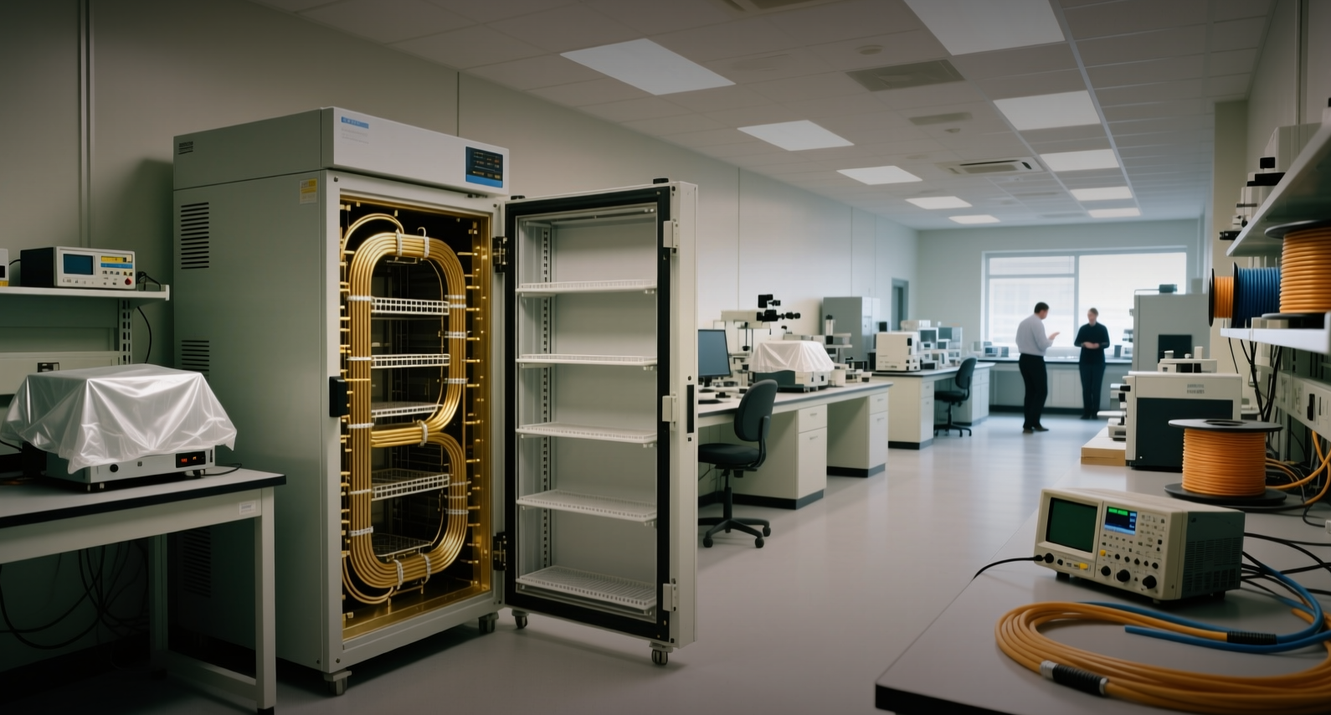
Washington has started buying pieces of the companies it funds. The Commerce Department closed $100 million CHIPS and Science Act awards to D-Wave Quantum, Rigetti Computing and Quantinuum, taking minority, non-controlling equity stakes in each — a $300 million package that repriced the listed quantum complex even as the S&P 500 fell 0.58% and the Nasdaq slipped 0.12% the same session.
"The administration has made clear that US quantum leadership will require not only breakthrough research, but also the ability to scale, commercialize, and manufacture these technologies," D-Wave Chief Executive Officer Alan Baratz said in a statement. "This award will help fulfill that mission by expanding domestic quantum capabilities, strengthening the underlying supply chain, and bringing increasingly powerful quantum systems to market."
The market read the structure, not the size. D-Wave (QBTS) closed up 6.57%, Rigetti (RGTI) gained 4.01% and Quantinuum added 1.65%, with Quantum Computing Inc. up 2.62% — four names rising on a day the benchmark index fell. The awards are R&D grants, not procurement contracts, meaning the cash funds engineering work rather than booking revenue. D-Wave will build a 100,000-qubit annealing system and a 10,000-qubit gate-model machine. Rigetti will shrink readout electronics, expand cryogenic capacity and accelerate chip fabrication. Quantinuum will develop integrated photonics with GlobalFoundries and Monarch Quantum, targeting next-generation ion traps and integrated lasers.
The $300 million is the small number. The larger one is $2 billion, the total CHIPS quantum allocation spread across nine firms, including a $1 billion quantum chip foundry for IBM in Albany, New York. GlobalFoundries separately finalized a five-year, $375 million milestone-based R&D agreement to expand domestic quantum manufacturing — after the government took a 1% stake in the chipmaker in July alongside $300 million for silicon photonics. The pattern is consistent: federal money arrives with a federal ownership line attached.
That is the break from precedent. The CHIPS and Science Act of 2022 appropriated $52.7 billion for semiconductor manufacturing incentives, and the program's first wave of awards — announced from December 2023 onward — were structured as grants and loans to fab builders such as Intel, TSMC and Samsung, with no equity component. The government's equity toolkit had been reserved for crisis instruments: the 2008 Troubled Asset Relief Program, which took preferred stakes in banks and automakers, and the 2009 auto restructuring that left the Treasury holding roughly 60% of General Motors at its peak. Applying that instrument to pre-revenue deep-tech R&D is new, and it changes what the discount rate on these stocks is supposed to be.
The repricing logic runs through the cash-burn line. Quantum hardware companies carry multi-year timelines to fault-tolerant systems, negative gross margins on early hardware and no near-term path to profitability — the profile that forces public-market investors to apply a funding-risk discount on top of ordinary execution risk. A sovereign co-investor does not eliminate that discount, but it shortens the tail: a company with the federal government on its cap table faces a materially lower probability of a dilutive down-round or a financing gap in a risk-off tape. Tuesday's moves were the market marking that probability down.
The year-to-date tape shows how much discount was embedded. D-Wave and Rigetti have each fallen more than 25% since January, and Quantinuum trades roughly 12% below its June IPO price — declines that persisted through a period of heavy quantum-sector news flow. A single $100 million grant does not reverse a nine-month drawdown, and the session's gains recovered only a fraction of it.
The supply-chain leg may prove the more durable trade. GlobalFoundries' $375 million agreement and IBM's $1 billion Albany foundry push federal money toward fabrication capacity rather than qubit counts, which is where the sector's binding constraint sits. Quantum processors require cryogenic systems, specialized semiconductor devices, lasers and optical hardware that currently have thin domestic manufacturing bases. Funding that layer lowers input costs and lead times for every hardware developer downstream, including names that received no direct award.
IonQ, which did not participate in the $300 million round, supplied the sector's other data point the same day. At its September 8 Investor Day the company raised 2026 full-year revenue guidance to $450 million-$460 million from a prior $280 million-$290 million, incorporating SkyWater Technology, which IonQ acquired, for the period from July 31 through year-end 2026. IonQ also unveiled the Superion 256, its sixth-generation architecture, saying it has manufactured initial integrated 256-qubit processors at SkyWater facilities and is taking customer reservations for delivery in 2027.
The execution test now sits with the contracts. D-Wave and Rigetti must hit technical milestones specified in their federal agreements, and IonQ must convert a 61% guidance increase into delivered revenue while holding margins — a combination that has no precedent in the sector. The next scheduled checkpoint is IonQ's first full quarter including SkyWater, with the Superion 256 delivery window in 2027 as the first hard date on the hardware calendar. If milestones slip, the government's equity stake becomes a mark-to-market problem for the Treasury rather than a validation for shareholders.
This article is for informational purposes only and does not constitute investment advice.