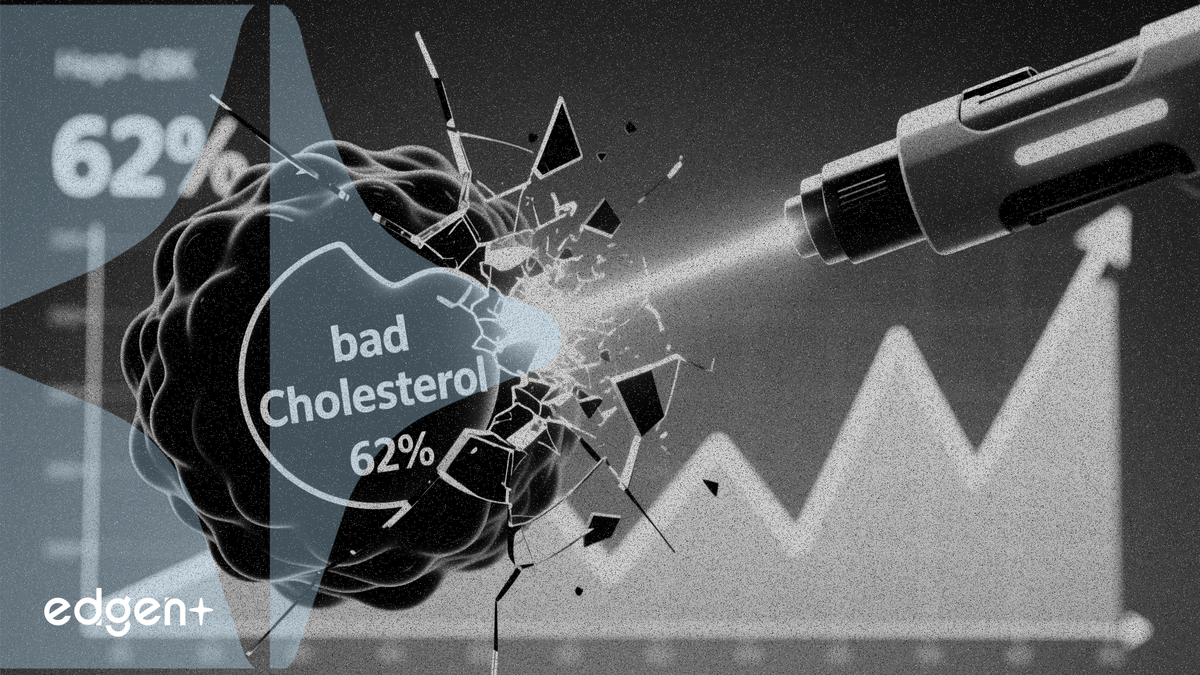
L'éditeur de base expérimental d'Eli Lilly, VERVE-102, a réduit le « mauvais » cholestérol jusqu'à 62 % avec une seule dose lors d'un essai clinique, un résultat qui pourrait bouleverser le marché de plusieurs milliards de dollars des traitements chroniques contre le cholestérol.
« Ces données préliminaires nous fournissent des preuves encourageantes que l'édition de base in vivo de PCSK9 pourrait offrir une nouvelle approche pour obtenir une réduction substantielle et durable du LDL-C avec un traitement unique », a déclaré Riyaz S. Patel, cardiologue au Barts Health NHS Trust et professeur à l'University College London.
Les résultats positifs proviennent de l'étude de phase 1b Heart-2 menée auprès de 35 participants souffrant d'hypercholestérolémie génétique ou de maladie coronarienne précoce. La dose la plus élevée de 1,0 mg/kg a entraîné une réduction moyenne du LDL-C de 62 % et a abaissé la protéine PCSK9 de 88 %. Ces effets ont été maintenus jusqu'à 18 mois, et le traitement a été bien toléré, sans événements indésirables graves.
Ces données positionnent Eli Lilly (NYSE : LLY) face à des inhibiteurs de PCSK9 établis comme le Repatha d'Amgen, qui nécessitent des injections répétées. En offrant une solution potentielle unique pour une pathologie à vie, le VERVE-102 pourrait transformer les soins cardiovasculaires, passant d'une gestion chronique à une intervention thérapeutique ponctuelle. Lilly prévoit de commencer un essai de phase 2 d'ici la fin de l'année.
Le VERVE-102 est un médicament d'édition de base in vivo, un type d'édition génique qui modifie précisément une seule lettre de l'ADN sans provoquer de cassure double brin dans l'hélice. La thérapie, administrée par une seule perfusion intraveineuse, est conçue pour désactiver définitivement le gène PCSK9 dans le foie. Les personnes nées avec une variante naturelle de perte de fonction de ce gène présentent un taux de LDL-C bas à vie et un risque de crise cardiaque nettement inférieur.
Cette approche diffère des traitements existants comme les statines ou les inhibiteurs injectables de PCSK9, qui font face à des problèmes d'observance des patients. « Nous savons que jusqu'à la moitié des patients ne prennent plus ces thérapies après un an », a déclaré Scott Vafai, médecin-chef chez Verve Therapeutics, une filiale à 100 % de Lilly, à Fierce Biotech. Un traitement unique éliminerait ce problème, qui est un facteur important de l'efficacité en vie réelle.
l'efficacité du VERVE-102 semble compétitive par rapport aux leaders actuels du marché. Le Repatha d'Amgen a montré des réductions de cholestérol comprises entre 50 % et 60 % dans ses essais pivots. La réduction de 62 % du VERVE-102 à sa dose la plus élevée franchit cette barre, avec l'avantage supplémentaire d'une baisse durable et stable, sans les fluctuations de taux de cholestérol parfois observées entre les doses des thérapies chroniques.
Lilly s'avance sur un terrain concurrentiel, avec des sociétés comme CRISPR Therapeutics et Scribe Therapeutics qui développent également des solutions d'édition génique pour les maladies cardiovasculaires. Cependant, les dirigeants de Verve estiment que leur approche d'édition de base, qui évite de couper la double hélice de l'ADN, minimise le risque de modifications génétiques involontaires. La Food and Drug Administration des États-Unis a accordé la désignation Fast Track au VERVE-102.
Cet article est uniquement à titre informatif et ne constitue pas un conseil en investissement.